

Property taxes are becoming a major conversation across Metro Atlanta and North Georgia, and now Hall County homeowners should be paying attention.
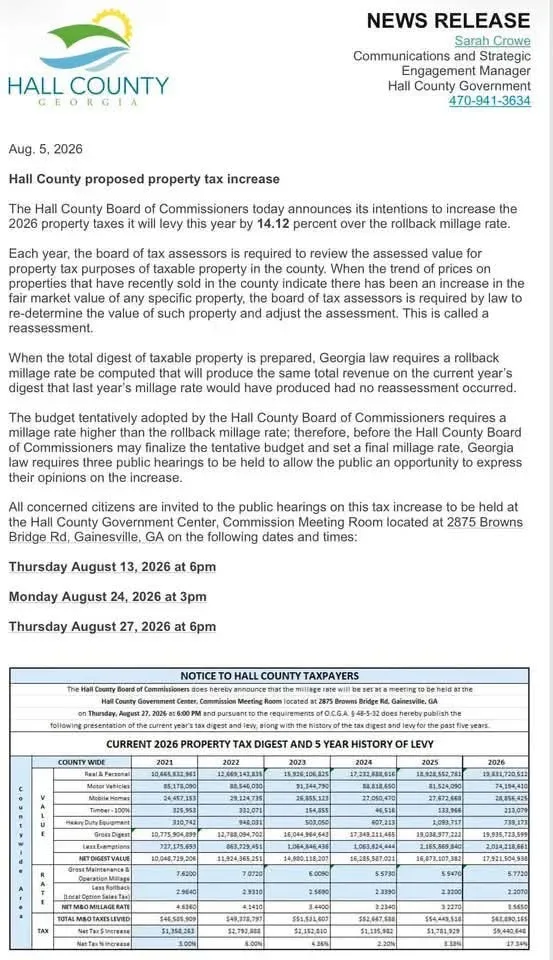
On August 5, Hall County announced a proposed 14.12% property tax increase over the rollback millage rate for 2026. But that headline number needs some explanation because it does not mean every Hall County homeowner's total property tax bill is going up 14.12%.
What Does the 14.12% Increase Actually Mean?
Georgia law requires local governments to calculate a rollback millage rate when property values rise due to reassessments. The rollback rate is essentially the rate that would generate approximately the same property tax revenue as the previous year, excluding new growth.
Hall County's proposed General Fund millage rate is 3.565 mills, compared with a calculated rollback rate of approximately 3.124 mills. Because the proposed rate is 0.441 mills higher than the rollback rate, Georgia law requires the County to advertise it as a 14.12% property tax increase and hold three public hearings before adopting the final rate.
Source: Hall County Government
Will Every Hall County Homeowner Pay More?
No, and this is where the story gets interesting.
Hall County says it is simultaneously proposing reductions in several other County tax districts. According to the County:
- Residents of unincorporated Hall County would see their combined County millage rate decrease by approximately 0.113 mills.
- Most residents living within Hall County's incorporated cities would see an overall decrease of approximately 0.078 mills.
- City of Gainesville residents would see an overall increase of approximately 0.302 mills.
That means the impact on an individual homeowner can vary depending on where the property is located, its assessed value, exemptions, and which tax districts apply to it.
Why Is Hall County Proposing the Increase?
Hall County says the higher General Fund rate would help cover additional court operations associated with the addition of a sixth Superior Court judge, including required staffing and related expenses.
Hall County Isn't the Only Georgia Community Talking About Property Taxes
The City of Brookhaven recently increased its operating millage rate from 2.74 mills to 3.85 mills, an increase of roughly 40% in the city millage rate. Brookhaven officials estimated that an $800,000 homesteaded property would pay approximately $355 more per year as a result of the city's increase.
The Brookhaven situation illustrates why homeowners throughout Georgia should look beyond a percentage in a headline and understand exactly which millage rate is changing and how that change affects their individual property.
Why This Matters for Real Estate
Property taxes aren't just a government-budget issue. They're a real estate issue.
For buyers, taxes affect the monthly cost of homeownership and can influence mortgage qualification and purchasing power.
For current homeowners, rising assessments combined with changing millage rates can affect annual housing costs, even when a home's mortgage payment hasn't changed.
And for sellers, property taxes are increasingly becoming part of the affordability conversation buyers consider when comparing communities.
Hall County Residents Have an Opportunity to Speak
Before Hall County adopts its final millage rate, three public hearings are scheduled at the Hall County Government Center, 2875 Browns Bridge Road in Gainesville:
- Thursday, August 13, 2026 at 6:00 p.m.
- Monday, August 24, 2026 at 3:00 p.m.
- Thursday, August 27, 2026 at 6:00 p.m.
The Bottom Line
The headline "Hall County proposes a 14.12% property tax increase" is accurate under Georgia's rollback-rate requirements, but it doesn't tell the entire story. Your actual tax bill depends on your property's assessed value, exemptions, location, and the combination of millage rates that apply to your property.
Thinking about buying, selling, or relocating in Hall County or Northeast Metro Atlanta? Understanding the true cost of homeownership goes far beyond the sales price. Let's look at the numbers, the community, and the market so you can make an informed real estate decision.

Lisa Harris
Real Estate Agent · REMAX Center · Chateau Elan Resident · 19 Years Experience
Learn more →Thinking of making Chateau Elan or Northeast Metro Atlanta your home?
Whether you are buying, selling, or just exploring, Lisa Harris is here to help. Call or email today to learn more about Hall County real estate, property taxes, and the Chateau Elan community.